 Industry Insight
OEM vs ODM: How Should Cross-Border E-commerce Sellers Choose Their Customization Model?
In cross-border e-commerce, OEM and ODM are the two customization models sellers encounter most often. Many beginners confuse the two, leading to wrong partnerships, higher cost and risk. This article breaks down the differences across four core dimensions to help you choose correctly.
1. Definition Difference
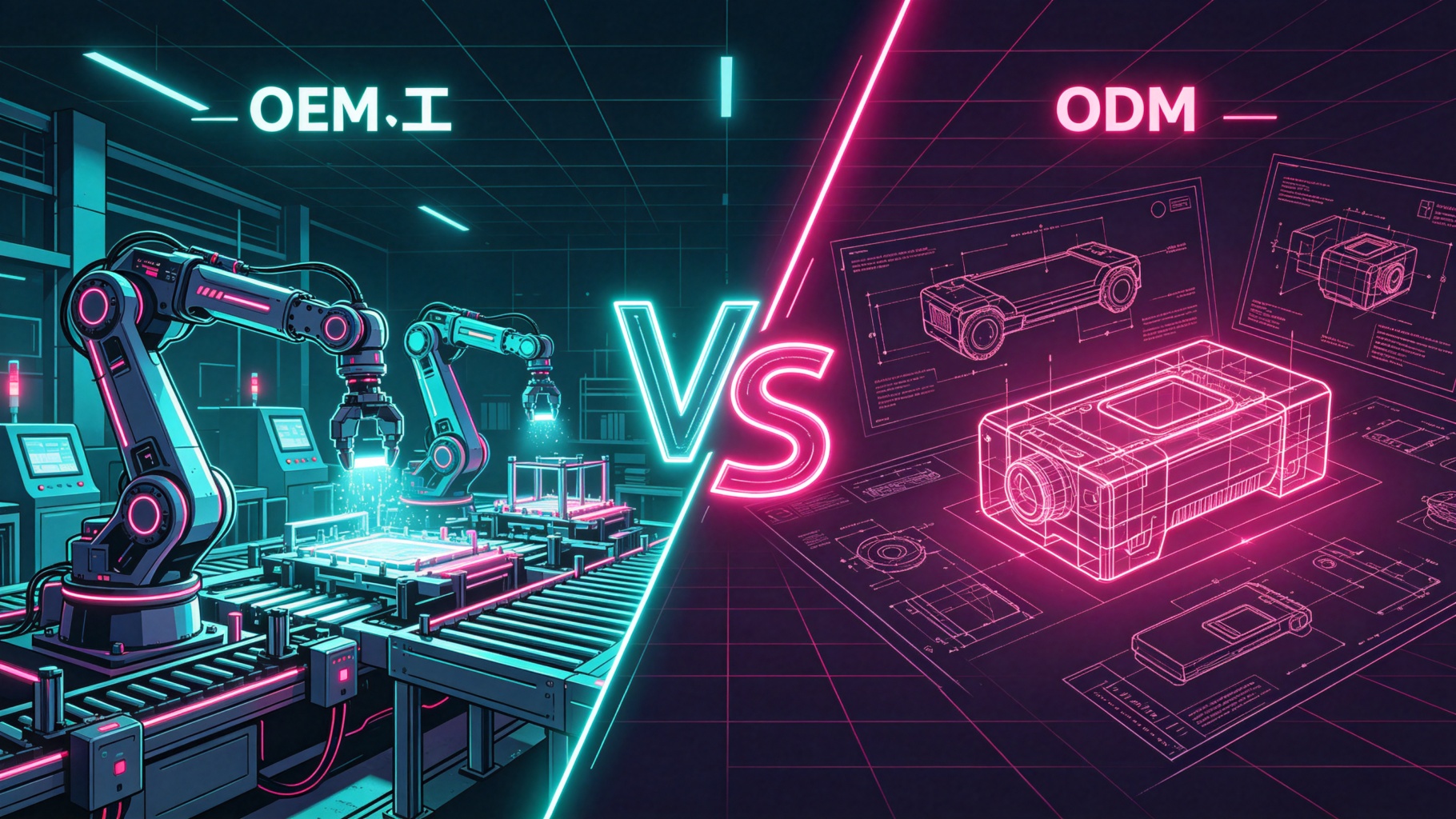
OEM (Original Equipment Manufacturer), commonly called "private label." The seller uses the factory's existing molds and design, only printing their own brand logo, custom packaging and manual. The product's core design, structure and function are decided by the factory; the seller customizes only at the brand level.
ODM (Original Design Manufacturer), commonly called "full customization." From exterior design, structural design, mold development, function definition to mass production — everything is led by the seller, and the factory produces per the seller's design. The seller owns the product's full intellectual property.
2. Cost Comparison
OEM cost is lower. Using existing molds means no mold development fee (typically ¥30k–80k per headset mold); unit price is relatively transparent. The seller only bears minor extras like logo printing and packaging customization.
ODM cost is higher. The seller pays upfront for mold development, design and prototype fees. A brand-new private-mold gaming headset mold runs ¥50k–150k, more for complex structures. But as an exclusive design it differentiates in the market and commands a higher price, yielding better long-term margins.
3. Production Lead Time
OEM lead time is shorter. With molds already existing, the factory can start quickly. From sample confirmation to bulk delivery usually takes 15–30 days — ideal for sellers needing fast replenishment or testing new products.
ODM lead time is longer. From design confirmation to prototype (7–15 days), mold development (20–30 days), first-sample confirmation (7 days), small-batch trial (7 days) to mass production — the whole cycle is typically 45–90 days. For brands with long-term plans to build exclusive lines, the time investment pays off.
4. MOQ Comparison
OEM MOQ is lower. Most factories set OEM MOQ at 100–500 pcs/model; some accept as low as 50. Very friendly to startups and small-batch market testers.
ODM MOQ is higher. To recover mold costs, factories usually require 500–2000 pcs/model; complex products even higher. This demands solid capital and sales channels to absorb larger orders.
5. Intellectual Property
Under OEM, the product's design IP belongs to the factory. The seller only has the right to use the brand trademark. This means other sellers can also OEM the same product, leading to homogenized competition and inevitable price wars.
Under ODM, the product's design IP belongs to the seller. The seller can file design and utility-model patents and exclusively own the design. The factory may not sell the same design to other customers. This builds a moat against homogenization.
6. How to Choose?
Choose OEM if: startup with limited capital; need to test market quickly; many categories with low per-SKU sales; main strategy is price and operations; no professional design team.
Choose ODM if: established seller with brand equity; expected high per-SKU sales (5000+/year); want an exclusive line to avoid homogenization; have a design/selection team; main strategy is differentiation and brand value.
7. Hybrid Strategy
For most growing cross-border sellers, a "OEM + ODM" hybrid is recommended:
- Use OEM products to quickly fill categories, test the market, accumulate capital and customers.
- Pick the 1–2 best-selling products and invest in ODM private-mold versions.
- Use ODM private-mold products as flagship to lift brand image and margins.
- Keep iterating, gradually upgrading more OEM products to ODM.
Conclusion
Neither OEM nor ODM is absolutely superior — what matters is fit with your stage and resources. Start with OEM to launch fast, use ODM to build barriers in growth, and establish a moat with your own brand at maturity. That is the growth path of most successful cross-border sellers.
Dongguan Mutong Yunchuang Technology supports both OEM and ODM, with a professional R&D team and mold design center, offering flexible customization for sellers at every stage. Whether you need small-batch OEM private label or full-process ODM private-mold development, we can meet your needs.